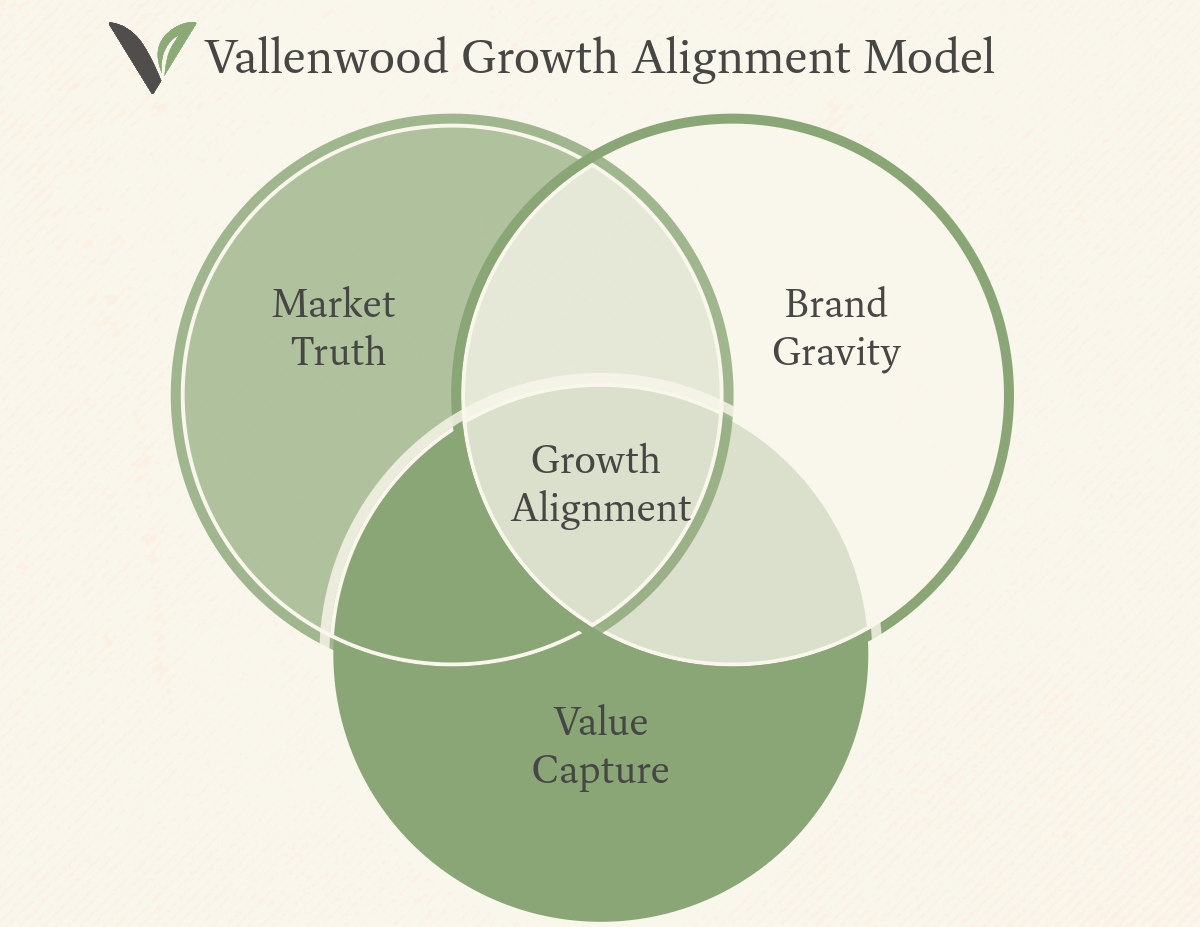
The Vallenwood Growth Alignment Model
After more than two decades leading sales, marketing, and go-to-market strategy inside some of the technology industry’s most respected companies, I’m stepping into a new chapter: fractional marketing leadership.
This isn’t a pivot—it’s a distillation.
It’s the natural outcome of years spent sitting at the intersection of brand, pricing, and go-to-market decisions that directly impact revenue, valuation, and long-term growth. Moving beyond a single product, company, or category allows me to apply that experience where it matters most: helping leadership teams make better strategic decisions, faster.
When I began thinking about how to differentiate myself in an increasingly crowded market of talented fractional leaders, I asked a simple question:
Why would I hire me?
The answer wasn’t a title, a résumé, or a list of services. It was a pattern I’d lived inside for years—one that consistently separated companies that scaled efficiently from those that stalled.
Growth breaks down when three decisions drift out of alignment:
How big the market really is
What the brand truly stands for
How value is priced, packaged, and captured
That insight became the foundation of what I now call The Vallenwood Growth Alignment Model.
The Three Pillars of Growth Alignment
At its core, the model brings together three strategic disciplines that are too often owned in isolation—but only work when designed together.
1. Market Truth
This is more than TAM slides and optimistic growth curves.
Market Truth is about grounding ambition in reality:
Who is truly buying—and why
Where demand is expanding, stagnating, or overstated
How competitors are positioned, priced, and perceived
What the market will reward over the next 12–36 months
We start here because clarity beats confidence. Every downstream decision—brand, pricing, investment—depends on an honest understanding of the market you’re actually in, not the one you hope exists.
2. Brand Gravity
Brand is not the paint job. It’s the force that pulls customers, partners, talent, and belief toward your business.
Brand Gravity defines:
Your narrative and point of view
The emotional and rational reasons customers choose you
The promise you consistently deliver—and the expectations you set
This work uncovers gaps between how leadership sees the company and how the market experiences it. When brand is clear and credible, it reduces friction across sales, hiring, partnerships, and expansion.
Strong brands don’t just communicate value—they create leverage.
3. Value Capture
Pricing is where strategy meets reality.
Value Capture focuses on:
How your offering is packaged and monetized
Whether pricing reflects perceived value—not internal cost structures
Where revenue is being left on the table or artificially constrained
How pricing reinforces (or undermines) your brand position
Great pricing strategy doesn’t simply optimize revenue—it signals confidence, maturity, and market leadership.
When Alignment Happens
Individually, each pillar creates improvement.
Aligned, they unlock momentum.
When Market Truth, Brand Gravity, and Value Capture reinforce one another, companies gain:
Sharper strategic focus
Faster decision-making
More efficient go-to-market execution
Sustainable, defensible growth
This is the difference between doing more marketing and building a growth system that compounds.
What This Means for Vallenwood Consulting
The Vallenwood Growth Alignment Model is the lens I bring to every engagement—whether advising founders, supporting executive teams, or stepping in as fractional leadership.
If you’re at an inflection point—new category, pricing pressure, stalled growth, or brand dilution—this model is designed to help you see the problem clearly and act decisively.
I’m excited to formally launch Vallenwood Consulting and share this framework more broadly.
If you’re curious about what alignment could unlock for your business, let’s talk.
You can connect with me on LinkedIn or schedule time directly through my website.