

Marketing Myopia: Why Your Value Proposition Won’t Always Hold—and How to Evolve Before You Lose Your Customer Base
When I was a relatively new brand manager, my workgroup was reorganized under new leadership. To kick off the transition, our new Vice President held an all-hands meeting at Intel’s headquarters and outlined a strategy for driving growth across the brands and businesses we supported.
It was a compelling presentation—clear, confident, and delivered with real enthusiasm. About halfway through, my direct manager leaned over and said quietly, almost apologetically, “We’ve literally done all of this before. None of this is new.”
There was no cynicism in his tone. Just experience.
He had been a marketing leader for decades and had seen enough cycles to recognize the likely outcome: not breakthrough growth, but more of the same. On the flight home, I kept thinking about what I would have done differently if I were in the Vice President’s seat. Would I really have had a fundamentally new perspective? Or would I, like so many leaders before me, have reached for a familiar playbook that once worked—and hoped it would work again?
That question points to a hard truth: eventually, every successful company reaches a stage where yesterday’s winning strategy stops producing tomorrow’s growth. The playbook that once felt innovative becomes mature. Execution excellence alone can no longer compensate for a value proposition that no longer expands the market.
Marketing Myopia Isn’t New—But It’s Still Dangerous
In 1960, Theodore Levitt famously labeled this phenomenon Marketing Myopia: the tendency for companies to define their business too narrowly and lose sight of evolving customer needs. His argument was blunt—companies don’t fail because markets dry up, they fail because leaders assume they’re in a “growth industry” and stop questioning what customers actually value.
It’s easy to spot marketing myopia in hindsight. The real challenge is preventing it in real time.
And while Levitt placed the blame squarely on leadership complacency, my view is more forgiving—and more structural. Most founders and CEOs don’t suddenly become disconnected from their customers. What does inevitably happen is market saturation. The segment that urgently needed—and highly valued—your original offering eventually becomes fully served.
When that happens, entropy sets in.
The Entropy of a Successful Value Proposition
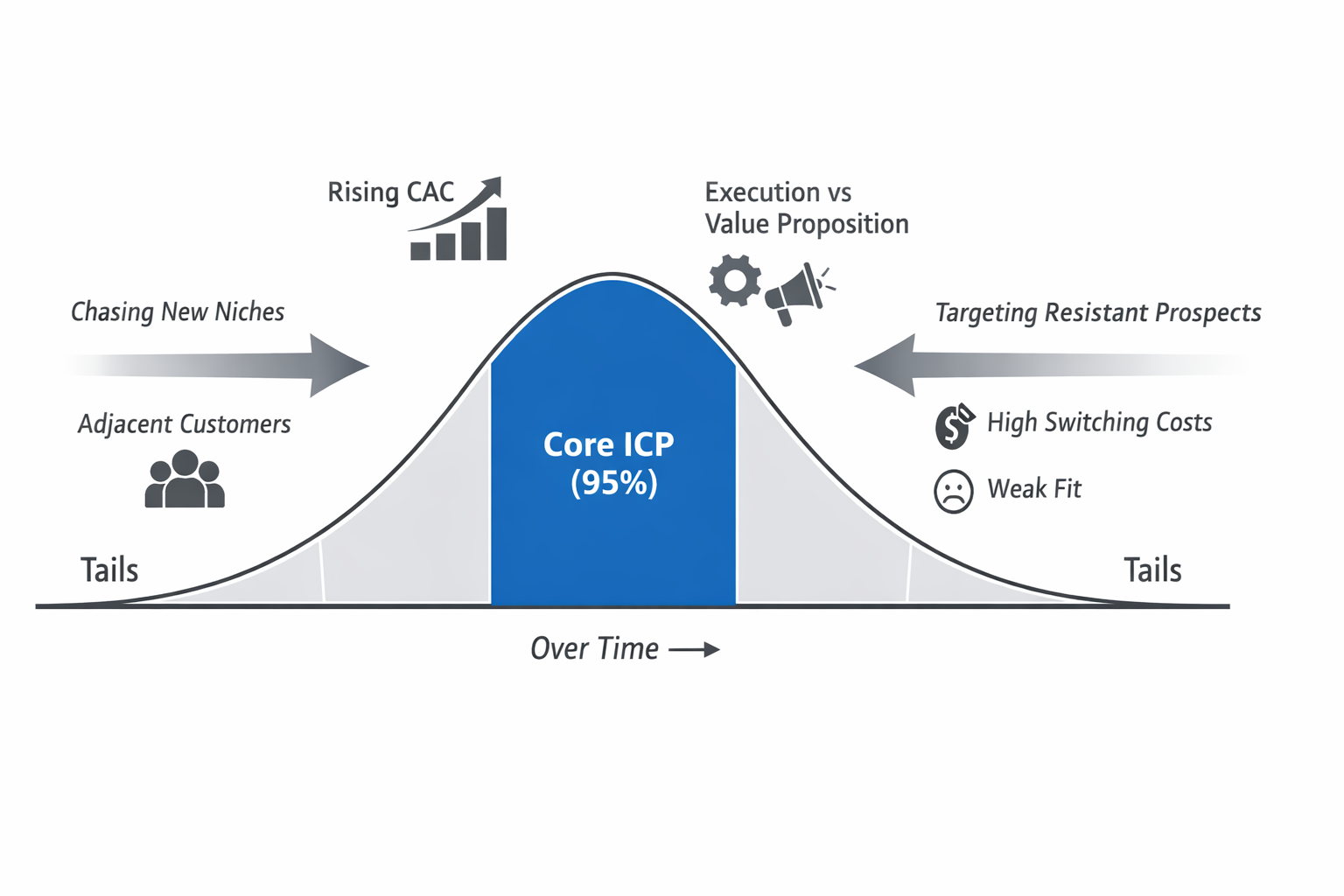
Early in my career, I worked in market sizing and forecasting, building econometric models to estimate total addressable markets and the share a product portfolio could realistically capture. Seen through that lens, marketing myopia is less about negligence and more about math.
If you imagine your ideal customer profile as a normal distribution, growth is initially fueled by capturing the broad middle of the curve—the 95% confidence interval of customers who strongly resonate with your value proposition. Once you’ve won that audience, growth doesn’t stop, but it does get harder.
What remains are the tails of the distribution:
Customers with adjacent but not identical needs
Buyers with higher switching costs or stronger incumbents
Prospects for whom your core value proposition is only somewhat compelling
In these segments, competition intensifies, acquisition costs rise, and differentiation weakens. Many companies respond by doubling down on execution—more campaigns, more spend, more features—while leaving the underlying value proposition untouched.
That’s the trap.
The solution is not to abandon your core value, but to evolve it—to reframe what you offer in a way that expands relevance to a broader and more diverse set of customer needs.
A Case Study: Adobe’s Shift from Product to Platform
Adobe provides a useful illustration of how companies can escape marketing myopia without abandoning their core strengths.
For years, Adobe was defined by boxed software products like Photoshop and Illustrator—tools beloved by creative professionals but increasingly constrained by piracy, upgrade cycles, and a narrow definition of who a “creative” customer was.
Rather than squeezing more growth out of that shrinking model, Adobe reframed its value proposition around creative workflows and outcomes, not just tools. The transition to Creative Cloud wasn’t simply a pricing change; it was a market redefinition. Adobe expanded its addressable market to include marketers, social media managers, small businesses, and enterprise teams who valued collaboration, speed, and integration as much as raw creative power.
The result was renewed growth, higher lifetime value, and a platform that could continuously evolve with customer needs—precisely the antidote to marketing myopia.
As Levitt himself warned, “The purpose of a business is to create and keep a customer.” Adobe did this not by clinging to its original definition of creativity, but by broadening it.
Breaking the Cycle: A Playbook to Avoid Marketing Myopia
Escaping marketing myopia doesn’t require radical reinvention. It requires discipline. Specifically, four practices that help organizations evolve before growth stalls.
1. Addressable Market Paranoia
Early success breeds confidence—and confidence can quietly become hubris. When a strategy works, it’s tempting to believe you’ve “figured it out.”
The antidote is healthy paranoia.
Assume your addressable market can shift faster than your planning cycles. Assume customer expectations will change. Assume competitors are looking for angles you’re not. This mindset doesn’t create fear—it creates readiness.
The comfort zone of today’s market is rarely where tomorrow’s growth comes from.
2. Scenario Planning as a Marketing Strategy
Paranoia is only useful if it’s productive. Channel it into structured scenario planning that pressure-tests your current and future value proposition.
Ask:
What happens if adjacent competitors redefine the category?
What if customers prioritize speed, integration, or outcomes over features?
What new buying roles emerge as the market matures?
These scenarios shouldn’t live in strategy decks alone. They should inform product roadmaps, messaging priorities, and go-to-market investments. Done well, scenario planning increases product velocity—not just in shipping features, but in delivering relevance.
Critically, involve customers in these conversations. Trusted advisors often appreciate being invited into forward-looking discussions, and their input can de-risk future bets.
3. Brand and Performance Marketing Velocity
Product evolution without marketing velocity creates friction. Marketing must be able to adapt narratives, value propositions, and proof points at the same pace as product change.
That requires a platform approach—one that balances brand-building with performance marketing and allows new offerings to plug into a coherent story.
This only works when marketers are embedded in scenario planning, not briefed after decisions are made. If product, brand, and performance teams operate in silos, velocity collapses.
Alignment isn’t a nice-to-have. It’s the operating system.
4. Making Change the New Normal
The final shift is cultural. Organizations must build a tolerance—and even an expectation—for change in the marketing playbook.
This doesn’t mean constant thrash or abandoning what works. It means viewing go-to-market strategy as a continuum, not a fixed campaign plan. Marketing success becomes less about individual launches and more about sustained relevance.
As Peter Drucker observed, “The greatest danger in times of turbulence is not the turbulence—it is to act with yesterday’s logic.”
The Cost of Standing Still
The gravitational pull of marketing myopia is strong. Familiar strategies feel safe, especially when they once delivered outsized returns. But markets don’t reward nostalgia.
Institutionalizing curiosity, scenario planning, and marketing velocity doesn’t guarantee growth—but it dramatically reduces the risk of being surprised by it.
If your growth story is slowing, or your value proposition feels increasingly expensive to defend, it may not be an execution problem. It may be a signal that your market definition needs to evolve.
If you’d like to explore how this framework applies to your business, I’m always open to a conversation about how Vallenwood Consulting helps companies rediscover momentum before it’s too late.